Axis Mundi and the Stomach Without End
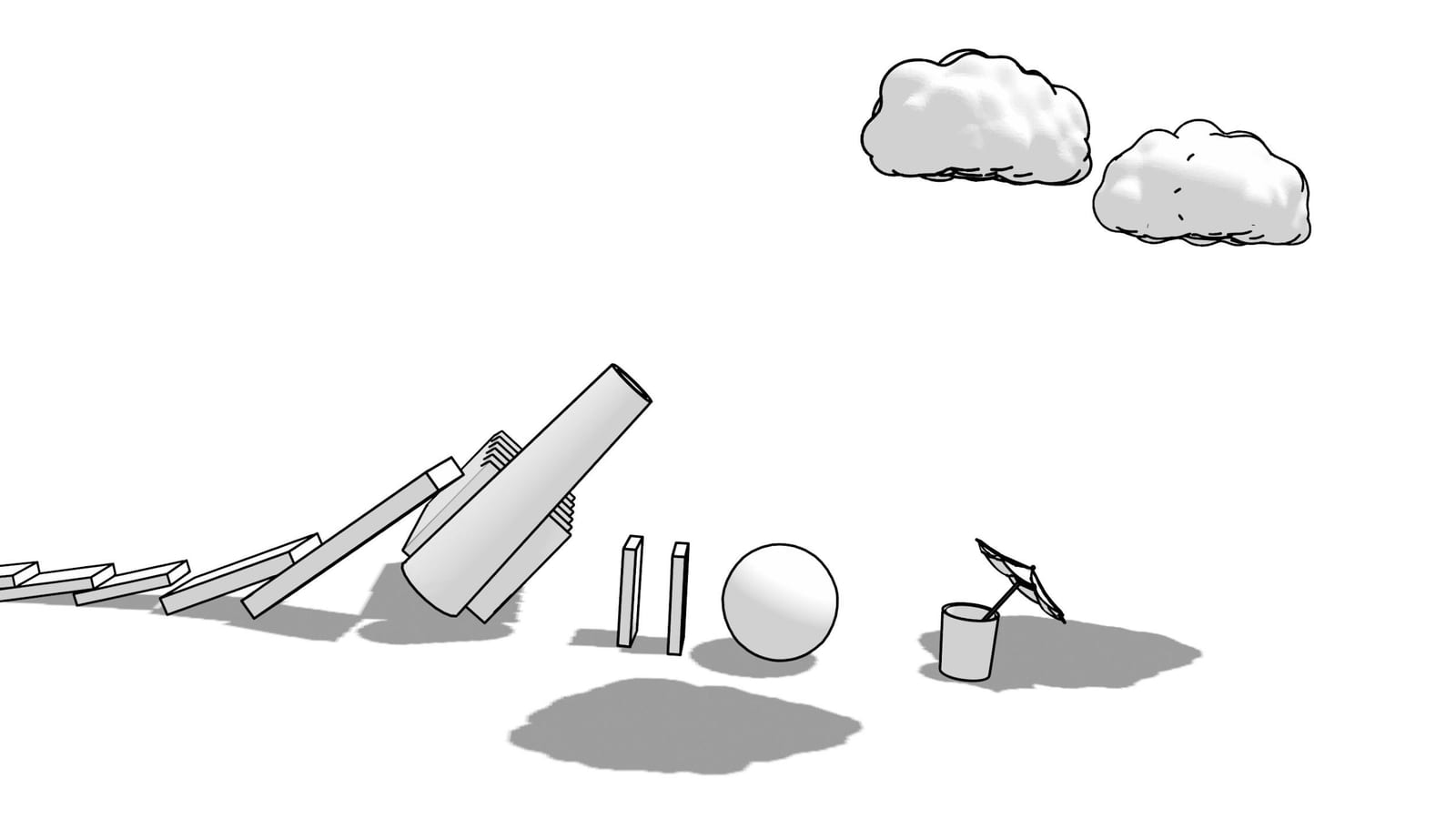
This 3D-animated short film is built on a fascination with scenarios, chain reactions and trains of thought linked to environmental and climate issues, but also the fluid uncertainty of human existence in the present. The film illustrates fragmentary stories about the insatiability of modern humans. Concept and animation by Jens Evaldsson; developed text and narration by the researcher Peter Lang.
Chain reactions – chains of thought. The most famous bridge over the Danube in Budapest is the Chain Bridge. Chain bridges have a tendency to start swinging back and forth and create vibrations. It is said that if an army marches in step across a chain bridge, the whole structure can collapse. Thinking in chains of thought can logically lead to thoughts being dissolved by excessive movement. The domino effect. Dominoes is a game with rectangular black wooden tiles with white dots painted in groups on each end. The domino effect describes how the tiles stand on edge in rows. When
the first tile in the row is knocked over, all the tiles in the row fall one after another, as in a constant flow. "The domino theory" was a term used often during
The Vietnam War, when the USA described its military intervention as necessary to prevent neighbouring countries from becoming communist states like Vietnam. The assumption could never be proven, but the concept clearly describes how great the effect can be. Technological spectacles: Paxton, Eiffel, Ferris. The Crystal Palace, London 1851; the Eiffel Tower, Paris 1889; Ferris, the Ferris wheel, Chicago 1893. All these world's fairs. In three exhibitions the future was revealed: modular buildings of glass, sky-high towers, wheels from the space age. While technology pointed the way, society was instead driven apart: those with privilege and those without. Think of all the countries that were invaded, plundered and violated to feed the fast-growing, power-hungry industrial nations that dominated as colonial overlords.